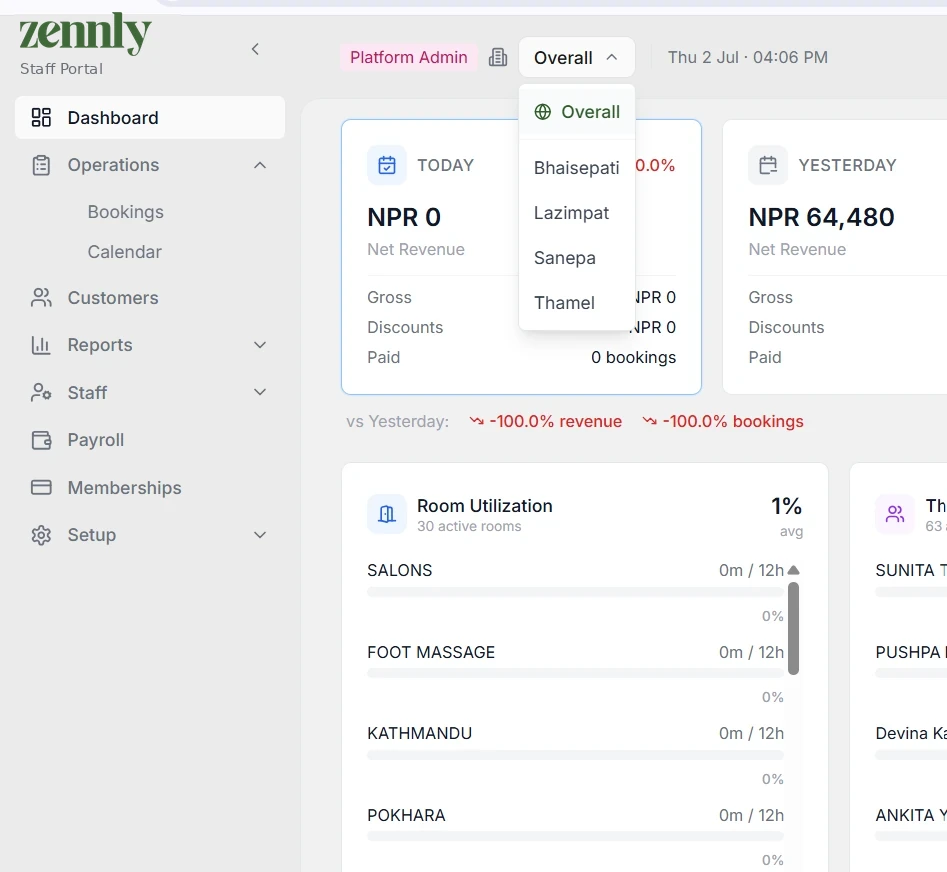
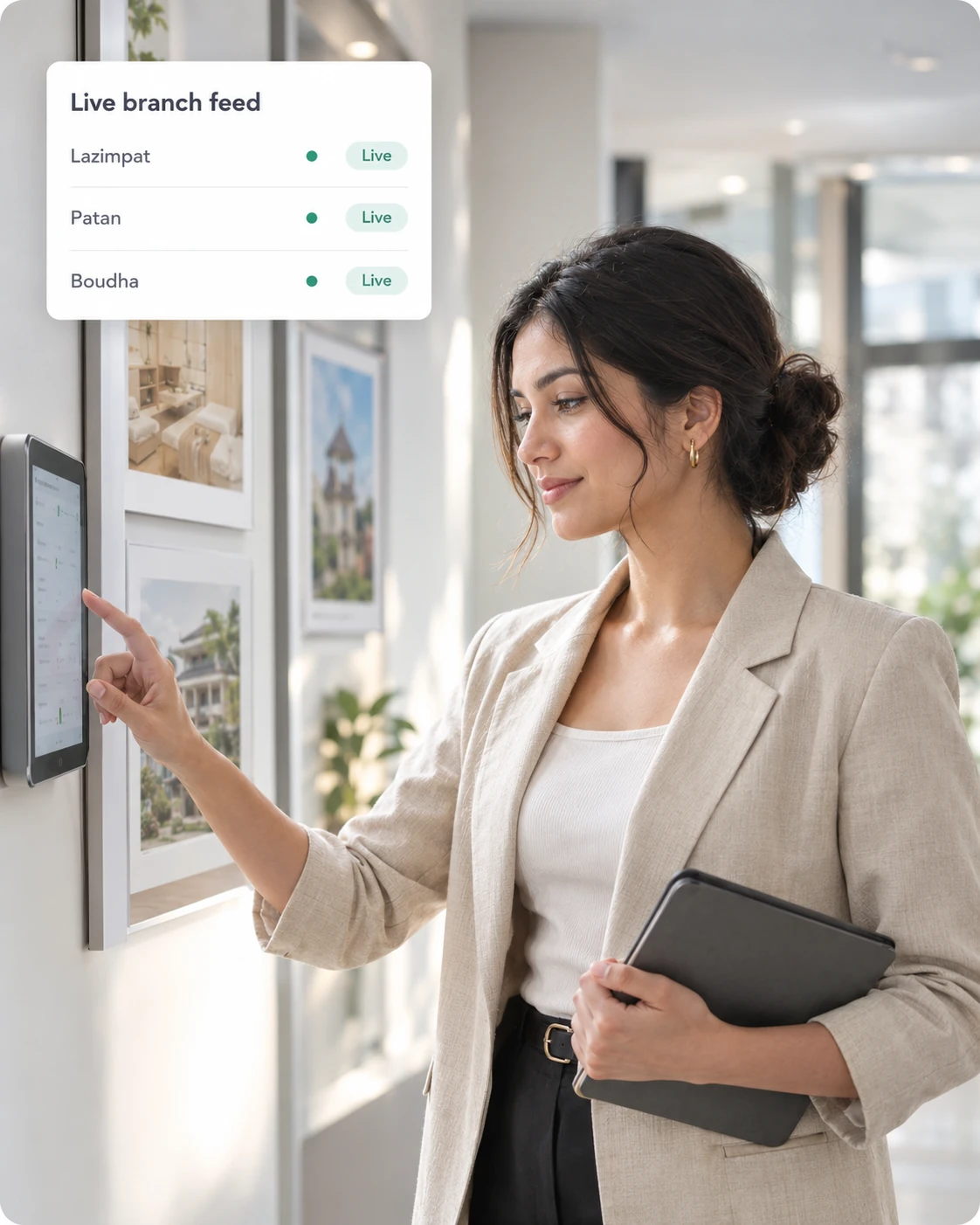
The week you open a second branch in Kathmandu, three things break at once: staff start belonging to two places, your service menu and prices begin to drift apart, and the daily close stops being something you can do by looking around the room. None of them is about the new branch being busy. They are all about the owner no longer being present everywhere.
Most owners plan the second branch carefully — the lease, the fit-out, the hiring — and then discover that the operational part was never the shop. It was the fact that a single branch runs on presence. You know who turned up because you saw them. You know what was discounted because you were at the counter. You know the cash is right because you counted it. Open a second branch and every one of those has to become a record instead, and that transition happens on day one whether you prepared for it or not.
Staff now belong to two places
Almost nobody opens a second branch with a completely separate team. A senior stylist or therapist covers both, at least at first, and often it is your best one — which means both branches want them on the same Saturday.
The version that fails is the one that runs on messages: the owner tells the second branch that the therapist will be there Tuesday, and the first branch, not having seen that message, books her for Tuesday afternoon. The client arrives at one branch and the therapist is at the other. In the Kathmandu valley you cannot fix this in the moment either; Thamel to Koteshwor is twenty minutes on a good day and considerably more at five in the evening.
What works is scheduling the movement in advance, as a transfer the system knows about, so bookings simply cannot be taken for someone at a branch they are not in that day. Sending a therapist to another branch covers the mechanics, including temporary transfers and recalling someone early.
The service menu starts to drift
This one is slow and almost invisible for the first month. The second branch adds a service the first does not have. A price gets rounded differently. A manager extends a treatment's duration because their room is slower to reset. Six weeks later the two branches are selling different things at different prices under the same name.
The cost shows up in two places: at the counter, when a client who paid one price at Lazimpat is quoted another at Baneshwor, and in your reports, where revenue per service is no longer comparable between branches — so you cannot tell whether the new branch is underperforming or just priced differently.
Decide early that there is one service menu and one price list, with differences only where you deliberately want them. It is a much easier rule to hold from the first week than to restore in the third month.
The daily close stops being a count
With one branch, closing is physical: you count the drawer against the day. With two, you are at best at one of them, and the other closes without you. The question "did yesterday balance at both branches?" has no answer unless both branches were recording payments the same way, against each booking, by method.
This is the point at which spreadsheets genuinely stop working rather than merely being annoying — two files, two people editing, no way to compare. Why spreadsheets stop working after your second branch goes through exactly where they fail, and what the daily close should take covers what replaces them.
Discounts, which is where the money actually leaks
At one branch you are the approval process. At two, whoever is senior at the other branch becomes one by default, usually without anyone deciding it. Small discounts given to keep a client happy are reasonable individually and add up to a real number across a month, and you will not find them afterwards unless each one was recorded with who approved it. Set the limits per role before you open, not after you notice. See discount approvals.
What to put in place before you open
- Both branches on one system, from the first day. Two calendars that have to be merged later is worse than it sounds — the client history cannot be joined up afterwards without doing it by hand.
- One service menu and price list, entered once and used by both.
- Staff assigned to a home branch, with any cross-branch work scheduled as a transfer rather than arranged by message.
- Discount limits per role, agreed before the second branch has its first busy Saturday.
- The same close at both branches, done daily, by method, against bookings.
- One morning report covering both, so you stop phoning two managers.
The owner's new job
With one branch, the owner's working day is in the branch. With two, a part of it becomes reading yesterday: bookings taken, services delivered, payments by method, discounts approved, per branch. It takes a few minutes and it replaces the thing most owners do instead, which is driving between branches to form an impression. Running branches without calling the managers covers what to look at and what to ignore.
Nuad Thai Spa Kathmandu went through this and now runs four branches, 39 therapists and 194 services on one account — the case study has the detail. For what Zennly looks like for a valley business specifically, see booking software in Kathmandu, or try the free demo with two branches set up.
Common questions
What changes when a Kathmandu salon or spa opens a second branch?
The owner can no longer be in both places, so anything previously known by being present — who turned up, what was discounted, whether the cash matched — has to be recorded instead. Staff shared across branches, a service menu that drifts between sites, and a daily close done differently at each one are the three failures that show up first.
Do both branches need to be on the same system from day one?
It is much easier than merging later. Two separate calendars means two versions of your service list, two price lists and no combined report, and the client records cannot be joined up afterwards without manual work.
How do you share a stylist or therapist between two branches in the valley?
Schedule the transfer in advance so the system knows which branch they are at on which day, and so bookings cannot be taken for them at the branch they are not in. A message on the morning does not stop the other branch booking them.
Should prices be the same at both Kathmandu branches?
Keep one service menu and one price list unless you have a specific reason to differ. Prices that drift between a Thamel and a Koteshwor branch produce arguments at the counter and make your revenue reports hard to compare.
How does an owner check two branches without visiting both every day?
Through one report covering both: bookings taken, services delivered, payments by method and discounts approved, per branch, for yesterday. That takes a few minutes and replaces the morning phone calls to each manager.
Which Kathmandu areas does this apply to?
Any of them. The valley's practical problem is that branches in Thamel, Lazimpat, Baneshwor, Koteshwor or across the river in Lalitpur are twenty minutes apart on a good day and an hour on a bad one, which is enough to make moving staff and cash between them something you plan rather than improvise.
Related reading
- Booking software in Kathmandu
- Managing multiple spa or salon branches: the checklist
- Sending a therapist to another branch without double-booking
- Why spreadsheets stop working after your second branch
- Running branches without calling the managers
- How to start a salon business in Nepal
- Case study: a four-branch spa in Kathmandu